Posts

Break Through in the Nutrition and Health

Image
In Nutrition and Health, Food safety has become one of the vital factors for the enrichment and quality of the food that is being developed these days. Small peptides and toxins can largely affect the food materials by disrupting the receptors or the enzymes present. This can affect in either form, such as internal or external forms. In order to avoid these contaminations and diseases, food safety management has developed various detection techniques which are capable of detecting various toxins and chemicals. Although, the factors such as sensitivity, specificity, etc is being detected by using the Atomic Force Microscopy. It is one of the widest nanotechnologies for imaging and measurements in biophysics and biology. Its high sensitivity in probing specific, single-molecule binding between molecules is applicable to food toxin detection. Elevating the ability to evaluate food quality and safety in a rapid, sensitive and reliable manner is of great importance in ...
AI applications in Healthcare

Image
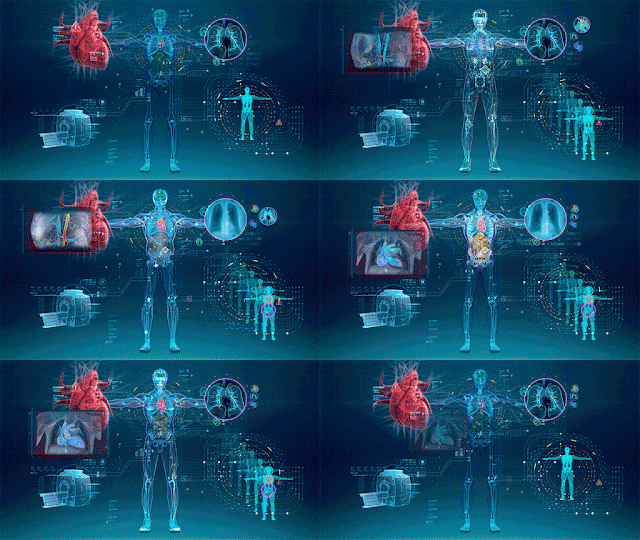
AI applications in Healthcare The field of health AI is far-reaching and covers a large area from wellness to diagnostics to operational technologies.                                                        The fields that are developed are listed accordingly: ·          AI-assisted robotic surgery . In orthopaedic surgery, a form of AI-assisted robotics can analyse data from pre-op medical records to physically guide the surgeon’s instrument in real-time during a procedure. It can also use data from actual surgical experiences to inform new surgical techniques. ·          AI-powered virtual nurse assistants have enormous potential in helping ...

Recent Advances in Drug Development

Image
                                                                          One in eight women is being diagnosed with breast cancer in her lifetime .Chemotherapy, which is one of the most followed therapy for cancer results in destroying the First –line cancer DNA-creating proteins, but BRCA genes have a backup plan that repairs the DNA and is carried out by poly-ADP-ribose polymerases (PARPs). The new class of breast cancer drug Abemaciclib , which belongs to CDK4/6 inhibitors have shown the most positive effect on metastatic breast cancer, especially in HER2+ breast cancers .This was designed as the breakthrough therapy Abemaciclib and is armed with certain advantages over its rivals. The clinical studies results have put Abemaciclib roughly on par with its competitors in the first-line settin...
Image
Scalp Cooling – An aiding principle in cancer? One of the fatal disease that kills half of the nation’s population is” Cancer”. Patients who are newly diagnosed by cancer are put in a situation where they must undergo a lot and the toughest part is the loss of hair. The inevitable loss of hair is often one of the hardest that most of the women undergo. New technology has raised in US where the researchers were looking forward to eliminating this problem from several patient’s lists of worries. The principle of “ Scalp Cooling ” majorly works by reducing the temperature of the scalp a few degrees immediately before, during and after chemotherapy has been shown to be highly effective for preserving hair in women receiving neoadjuvant or adjuvant chemotherapy for early-stage breast cancer.                                                       ...

Another breakthrough in 3D printing technology?

Image
The recent breakthrough in the field of stem cell technology is that, for the first time, researchers developed a customized low-cost 3D printer to print electronics on a real hand. This technology could be used by soldiers on the battlefield to print temporary sensors on their bodies to detect chemical or biological agents or solar cells to charge essential electronics which will be one of the driving factors. Researchers also successfully printed biological cells on the skin wound of a mouse where the principle of the technique lies in developing new medical treatments for wound healing and direct printing of grafts for skin disorders. One of the major advancement of the new 3D-printing technique is that this printer can adjust to small movements of the body during printing. The skin is scanned by placing temporary markers on the skin. The printer uses computer vision to adjust to movements in real-time. This 3D-printing technique also includes a rare feature where it uses...

Nano medicine – A promising cure for cancer?

Image
Nano technology is one the phenomenal tool in the field of medicine where the cure for diseases became much easier. The resources being implemented into nanotechnology across the research world seems to indicate that nano medicine may become a common part of healthcare. Nanotechnology also increases the efficiency of pharmaceutical research. The most significant factor of nano medicine or Nano technology is its targeted nature where it reduces the time taken for the researchers to observe feedback on several trials and treatments which they perform.                    Focusing on the targeting nature of the Nano technology tools scientists have developed a tool which targets only the cancerous cells reducing the side effects and other issues which are caused by the treatment of chemotherapy. Nano probes were developed where the cancer cells can be destroyed by overheating the probes ...

CRISPR - The right technology for the "cure"

Image
CRISPR - Clustered Regulatory Interspaced Short Palindromic Repeats, a family of the DNA sequence in bacteria contains snippets of DNA which are used by the bacterium to detect and destroy the DNA of viruses which is considered as a defense system for the bacteria .This has been used as a effective tool for changing the genes within the organisms. In the treatment of AIDS, DNA of the HIV is inserted into the genome of the host where it can lay dormant for years and its effects can be changed slightly as the virus cannot be made to remain in the inactive state permanently. In the recent days, scientists proved that it is possible to cut the HIV cells out of living cells of patients in a laboratory using CRISPR. Currently, they carried out an experiment in the lab with the rats which had HIV in 99 per cent of their cells. By injecting CRISPR into the rat’s tails, they were able to remove 48 per cent of the virus from the DNA of their body cells. Although the experiments are do...